Review of 9 Energy‑Storage Fire Accidents
Classification:Industrial News
- Author:ZH Energy Tech Team
- Release time:Aug-07-2026
【 Summary 】Nine confirmed major lithium-ion ESS fires worldwide (May–July 2026): dissecting the chemical defects behind thermal runaway and how flow batteries eliminate fire risk at the source.
Between May and July 2026, nine confirmed major fire accidents took place across global lithium‑ion battery energy‑storage systems. Both mainstream NMC and LFP cell chemistries suffered failures: self‑ignition of an ageing grid‑tied storage station after nine‑year service, fire of brand‑new uncommissioned storage containers at rest, residential storage explosions causing personal injury, and city‑wide public‑service breakdown triggered by data‑centre fires.
The industry has long relied on passive protections including BMS, sprinkler systems and thermal control. Nevertheless, multiple accidents prove such post‑event protection cannot respond to millisecond‑scale thermal runaway. Energy‑storage safety has become a core bottleneck restraining large‑scale deployment of new‑generation power systems. This article reviews the nine full fire cases, digs into root chemical causes of lithium‑ion fires, and illustrates how redox‑flow batteries avoid thermal runaway from electrochemical principles. It offers references for safety‑oriented product selection and system design for storage practitioners and researchers.
Nottinghamshire, UK – 1 May
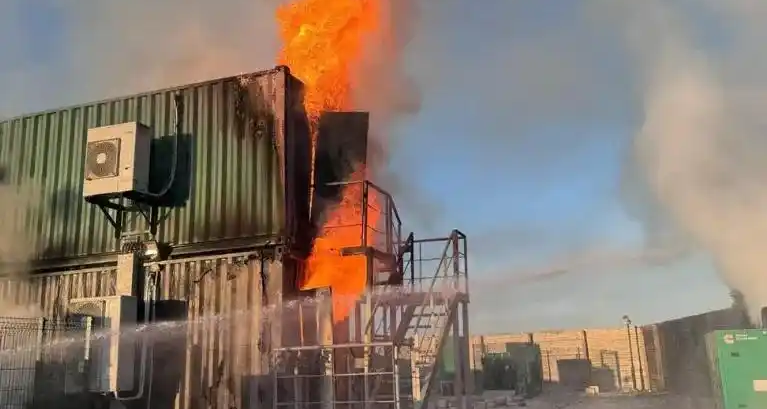
A 7 MW grid‑scale energy‑storage station equipped with LG NMC cells, commissioned in 2017 with double‑deck container layout. Severe combustion occurred inside stacked containers. Four fire‑station teams were dispatched. Investigation traced ignition to internal short‑circuit of NMC cells.
2. Poland – 7 May
A 2 MW container‑based storage system for on‑site PV self‑consumption at a factory. It housed roughly 107 000 cells with total weight of 18 tonnes. Delivered on 6 May for upcoming installation, it started smoking less than 24 hours after arrival while fully unpowered, outside BMS supervision. Firefighters applied sand covering and water cooling with drone thermal imaging, yet could not stop fire spread.
3. Almere, Netherlands – 7 May
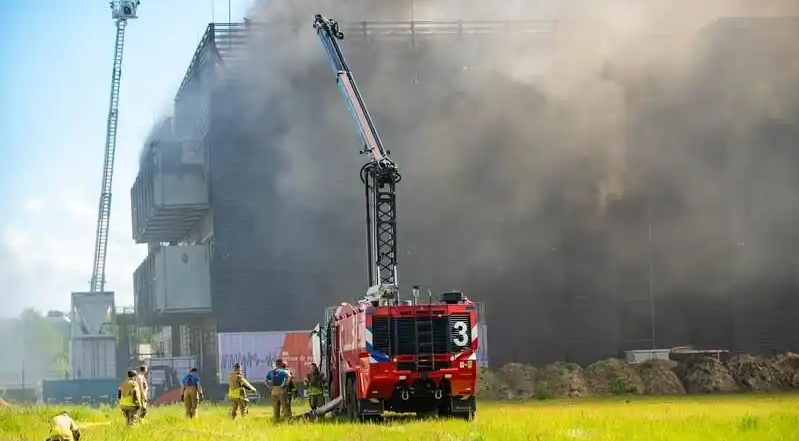
Fire broke out within the 11 MW lithium‑ion backup storage at NorthC Data Centre. The large‑scale blaze lasted about 12 hours before containment. Fire units deployed fire engines, aerial ladders and robotic fire equipment, with airport fire resources for pre‑cooling diesel tanks. The incident disabled IBM cloud services, municipal traffic dispatching systems and university campus networks, exposing cascading‑failure risks for urban critical infrastructure.
4. Shenzhen, China – 12 June
An outdoor LFP energy‑storage cabinet at an industrial park caught fire in early morning. Over‑charging induced cell overheating and thermal runaway with heavy smoke and deflagration. Fire crews arrived shortly after alarm and extinguished open flames. This accident demonstrates that even LFP cells with superior thermal stability will go into thermal runaway once system‑level protection fails.
5. Los Angeles, USA – 17 June
Fire originated from suspected short‑circuit during third‑party contractor testing on rooftop PV panels at a cold‑storage facility. Flames spread onto PV modules, ruptured ammonia refrigeration pipelines and ignited high‑density foam insulation. Helicopters conducted aerial water dumping; the fire persisted for four days. Superimposed hazards of PV, battery storage, ammonia refrigeration and combustible insulation exceeded conventional firefighting capabilities.
6. Rostock, Germany – 5 July
A residential PV‑coupled energy‑storage unit housed inside a wooden backyard shed overheated and ignited surrounding combustibles. A violent explosion happened during fire‑fighting operations. The shed was completely destroyed; flying debris damaged two neighbouring residential buildings.
7. Berkeley, California, USA – 26 July
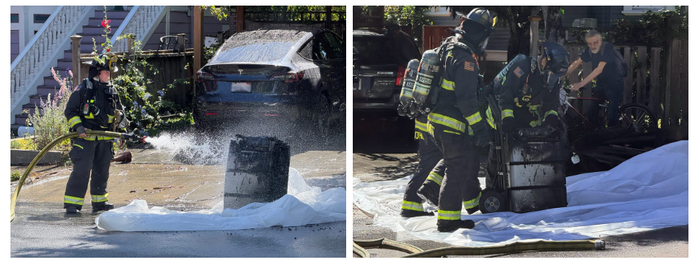
Outdoor residential lithium‑ion storage for rooftop PV and EV charging suffered sudden thermal runaway. Flames spread rapidly to nearby trees and reached roof height. Residents reported pre‑fire odour of burning insulation. Firefighters removed and isolated the defective battery assembly.
8. Visalia, California, USA – 29 July
A home energy‑storage system inside a backyard shed was fully engulfed by fire. Even after open flames were put out, batteries kept undergoing thermal runaway with extreme heat and toxic emissions. Authorities issued shelter‑in‑place orders for around ten households and closed adjacent roads until internal battery reactions terminated.
9. North Carolina, USA – 29 July
A lithium‑ion‑battery‑housing container at a logistics site caught fire. Given the difficulty of complete extinguishment, fire services set up a large‑radius evacuation zone and implemented perimeter control, allowing battery packs to burn to completion. The container was dismantled the following day.
These nine utility‑scale, C&I and residential incidents confirm thermal runaway is an intrinsic hazard for both NMC and LFP chemistries, not a cell‑specific defect.
Thermal runaway is a self‑catalytic chain reaction. Beyond critical temperatures, sequential exothermic events occur: SEI‑film breakdown, anode‑electrolyte reaction, separator melting and internal short‑circuit, cathode oxygen release, and electrolyte combustion. Cell temperatures surge above 400 °C in seconds, releasing flammable and toxic gases. Critically, cathode‑derived oxygen sustains combustion without external air.
Lithium‑ion fires pose severe response challenges: oxygen from cathodes invalidates smothering; re‑ignition risks persist for hours or days; toxic fumes demand full protective gear; high voltage restricts direct water use; dense cell packing speeds cascading thermal spread.
In most real emergencies, firefighters can only isolate zones and wait for full burnout, endangering front‑line crews.
Redox‑flow batteries neutralize thermal runaway through core design, not just post‑fault safeguards.
Non‑flammable aqueous electrolyteWater‑based electrolytes (≥50% water) cannot burn, unlike lithium‑ion’s flammable organic solvents. They only vaporize under heat.
Decoupled energy and powerLithium‑ion packs dense energy in solid cells, enabling rapid thermal spread. Redox‑flow stores active materials in external electrolyte tanks, with reactions in stacks. Circulating electrolyte acts as coolant; pump shutdown instantly cuts off reactions, avoiding concentrated energy buildup.
No thermal‑runaway chain reactionsOperating at ambient to 50 °C, well below decomposition thresholds. Under overcharge or short‑circuit, flowing aqueous electrolyte dissipates heat; only manageable water‑electrolysis gas is produced. No cathode oxygen release or separator melting occurs. Stable idle electrolytes eliminate dormant self‑ignition in transit or storage.
Redox‑flow batteries do not replace lithium‑ion, which excels in space‑limited, high‑power uses. But these incidents highlight where intrinsic safety comes first.
High‑occupancy C&I and residential areasNear offices, dorms and populated zones, non‑flammable redox‑flow systems need minimal safety buffers and can be sited close to loads.
Data centres and critical infrastructureAI‑driven GWh‑scale storage raises lithium‑ion cascade risks, threatening costly public‑service collapses. For mission‑critical sites, intrinsic safety is a non‑negotiable baseline.
Grid frequency regulation (high‑cycling)Heavy daily cycling degrades lithium‑ion cells, raising risks long before end‑of‑life. Redox‑flow delivers 15,000–20,000+ cycles; capacity fade is reversible via electrolyte rebalancing, with no thermal‑runaway paths.
Logistics and pre‑commissioningUnmonitored lithium‑ion units face micro‑short risks in transit. Redox‑flow’s stable idle electrolytes eliminate self‑ignition during delivery and setup.
The nine 2026 fires send a clear warning: lithium‑ion safety risks cannot be fixed by incremental upgrades or dismissed as rare.
Practitioners must choose: batteries that are harder to ignite, or chemically incapable of thermal runaway. Redox‑flow may not minimize size or upfront cost, but it erases the top systemic hazard at the electrochemical source. For safety‑critical deployments, intrinsic safety is the most critical performance metric.