FE-PBI Membrane for Zinc-Iron Flow Batteries: 800h Test, EE 85.56%
Classification:Industrial News
- Author:ZH Energy Tech Team
- Release time:Nov-25-2026
【 Summary 】To solve the membrane challenge in safe, low-cost alkaline zinc-iron flow batteries, researchers used rigid ethylene bonds instead of flexible ether bonds. This molecular upgrade stops the membrane from breaking down in strong alkali, achieving 800 hours (500 cycles) of stable operation and 85.56% energy efficiency.
01 A cost-effective route pressed by a membrane
Zn–Fe in flow batteries is a "unique" material: its theoretical voltage is about 1. 79V, which is 40% higher than the 1. 26V of all-vanadium systems; the alkaline aqueous electrolyte is non-toxic and highly safe; in terms of cost, the Zn–Fe electrolyte costs approximately $0. 64 per liter, while all-vanadium electrolytes cost between $3. 7 and $7. 1 per liter, less than one-tenth of the all-vanadium price. With high voltage, inexpensive materials, and inherent safety, this path has always been hindered by membranes.
02 Three types of membranes, three types of compromises
Nafion perfluoropolymer membrane Stable but costs over $500/m², with average alkaline conductivity。
PBI Membrane Below $10/m², acid and alkali resistant, but with low conductivity due to short chains and crowded channels。
Mainstream modification Involves the introduction of ether bonds (─O─) to lengthen the chain and create O-PBI, which increases the channel size and conductivity. However, ether bonds easily coordinate with metal ions in strong bases, causing chain entanglement and stacking, and resulting in the collapse of the channel. "Capacity enhancement" and "stability" are mutually exclusive issues in ether bond systems。
The joint team from City University of Hong Kong and Macau University offers a new solution: replacing the connecting unit from flexible–O– with rigid vinyl (–C=C–), namely the FE-PBI membrane. The rigidity brings two effects: "mutual support" is formed between segments, stabilizing the channels; under strong alkali conditions, there is no mutual locking or stacking. –C=C– carries almost no negative charge, preventing metal ions from binding and cutting off the entanglement dynamics. What remains is a highly ordered, high-throughput "ionic highway".
The key data provided in the paper are clearer when examined item by item:
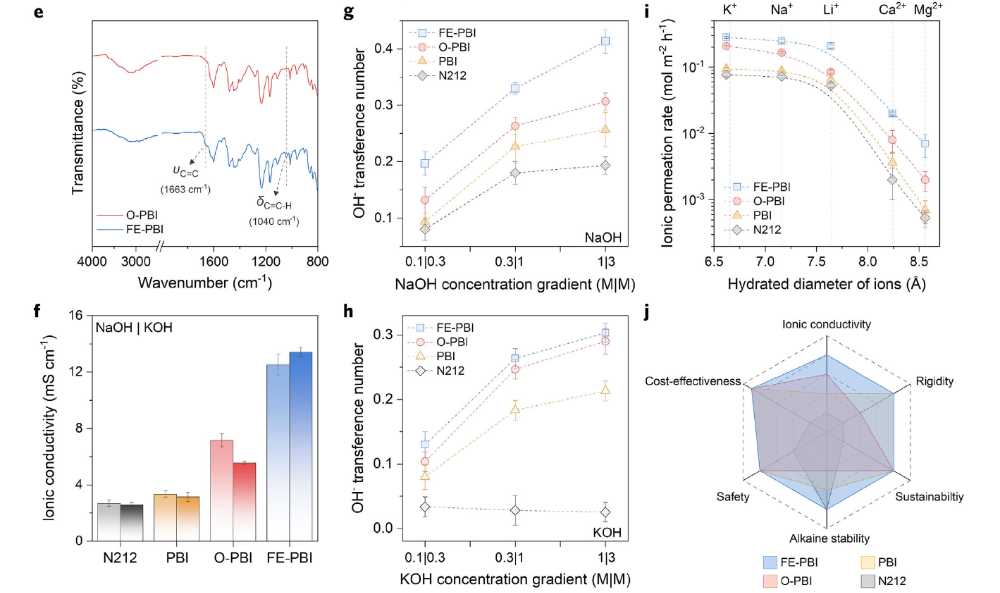
conductivity Ion conductivity exceeds 12 mS/cm.
migration number Under a 1M|3M NaOH gradient, the OH⁻ migration number of the FE-PBI membrane is 0. 41, which is higher than that of O-PBI (0. 30), commercial PBI (0. 26), and N212 (0. 19).
sieving The screening stops at about 8.0Å; K⁺, Na⁺, and Li⁺ hydration ions pass quickly, while Fe(CN)₆³⁻ at 9.5Å is blocked outside the membrane, preventing cross-talk of active substances.
alkali resistance After aging at 60℃ for one month with 3. 8M NaOH, the commercial PBI and FE-PBI remain in good condition, while O-PBI shows surface deformation. The conductivity of FE-PBI membrane is 12. 5→11. 2mS/cm; that of O-PBI is 7. 2→2. 9mS/cm, with a reduction of 58%.
| long-term cycle 500circle | energy efficiency almost no attenuation | battery internal resistance full battery |
Semi-battery: The zinc asymmetric battery still maintains stable deposition at 240mA/cm², with a mean CE of 99. 41% (O-PBI at 98. 59%), after 240 hours of cycling (O-PBI around 100 hours). SEM and XRD indicate that zinc forms ordered hexagonal flakes—not by pressing down on the dendrites, but by allowing zinc to grow in an orderly manner.
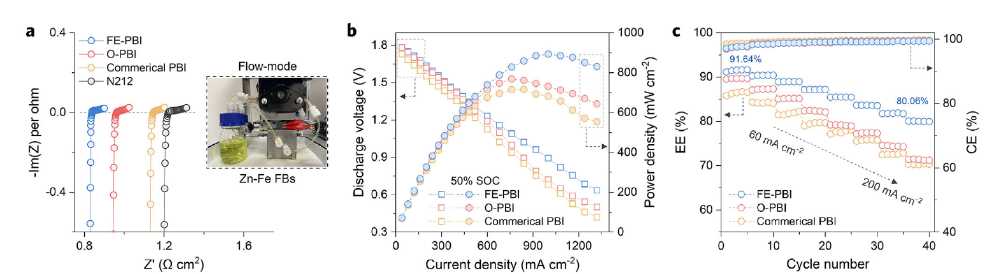
Full battery: low internal resistance of 0. 83Ω·cm², with peak power density at 50%/70%/90% SOC being 893/1043/1202. 4 mW/cm².
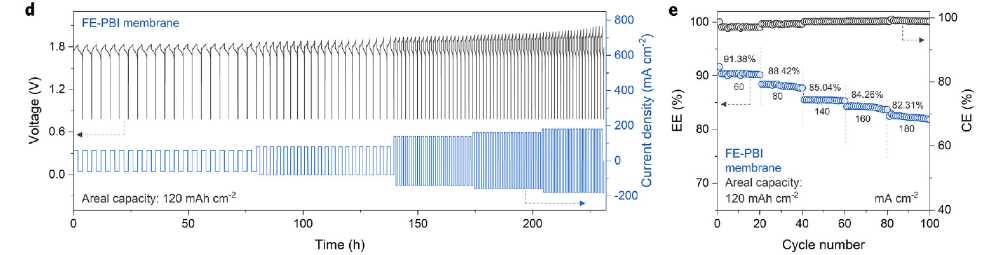
At 200mA/cm², CE exceeds 99. 34% and EE exceeds 80. 06%.
Surface capacity is 120 mAh/cm², and the efficiency in the range of 60–180 mA/cm² still ranges from 91. 38% to 82. 31%.
The most stringent requirements: 100mA/cm² + 80mAh/cm²: 500 turns, over 800 hours, CE99. 33%, EE85. 56%, with almost no degradation. The control group used commercial PBI for 120 turns and O-PBI for 240 turns.
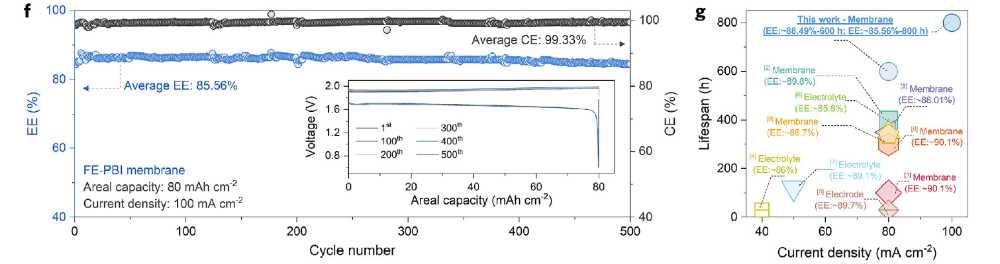
Once channel stability is broken through, the current density, surface capacity, and lifespan of the stack can be reconfigured—the same stack can accommodate more power, the same storage tank can last longer, and the cost per kilowatt-hour can achieve a new downward trend. For the zinc-iron route, this represents a revaluation of the limits.
There is still a long way from papers to engineering: material consistency in real power plants, channel uniformity after scaling, and long-term impurity accumulation all require reliable platform validation. The testing equipment for neutral energy storage and the validation capabilities of power plants are the main forces to cover this part.
The membrane is not a passive barrier, but an active component that determines how fast and for how long the system can operate. Only when the molecular structure of the membrane is redesigned, and the cost-performance narrative of zinc-iron flow batteries is fully realized, can the final piece of the picture be completed.