How to choose the membrane of flow battery? Comparison of PBI/SPEEK/SPPSU Membrane Selection
Classification:Company News
- Author:ZH Energy Tech Team
- Release time:Nov-18-2026
【 Summary 】Neutralization and energy storage three series of non-fluorine ion exchange membranes (PBI, SPEEK and SPPSU) support roll-to-roll large-scale preparation, and have completed multiple rounds of accelerated aging and long-cycle verification of the stack, all of which have been verified by domestic and foreign customers. Technical parameters are attached to this paper for reference.
Ion exchange membrane is the core component that determines the efficiency, cycle life and system cost of flow battery stack.
Perfluorosulfonic acid membrane is widely used because of its stable performance, but high cost, large self-discharge and environmental pressure of fluorine materials have become practical obstacles to the large-scale landing of high-power long-term energy storage. How to balance the inherent Trade‑off between ion conductivity and ion selectivity and develop non-fluorine films with high electrical density, low permeability and high mechanical strength is an urgent task for the industry.
Three series of non-fluorine ion exchange membrane products for neutralization and energy storage: Porimion® high-density liquid flow battery membrane (PBI), SPEEK liquid flow battery membrane and SPPSU liquid flow battery membrane. Covering all vanadium, titanium bromine, zinc manganese, zinc bromine, zinc iron, and all iron flow battery systems.
Product features
High strength and ultra-thin:The tensile strength and puncture strength are improved by more than 100% compared with that of perfluorosulfonic acid membrane, and carbon fiber puncture is not afraid. The thickness of homogeneous membrane used for electric stack is reduced to 25 microns, which significantly improves the current density.
high selectivity:Proton conductivity reached the same level as that of perfluorosulfonic acid membrane, while vanadium ion permeability decreased by one order of magnitude, which significantly improved coulombic efficiency and energy efficiency.
Low self-discharge:The extremely low vanadium ion permeability can increase the coulombic efficiency of vanadium battery to more than 99%, and the self-discharge rate in operation is greatly reduced, which is especially suitable for FM scenes with long-term uninterrupted operation.
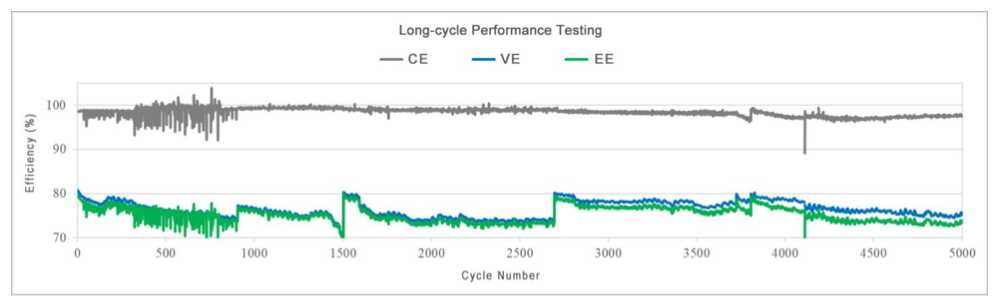
high reliability:After 5000 cycles of accelerated aging test, the battery performance has no attenuation.
Environment friendly:Fundamentally put an end to the pollution of permanent plastics-fluorine-containing compounds to the environment, which is green and degradable and meets the requirements of the defluorination act of the European Union and North America.
Specification parameter
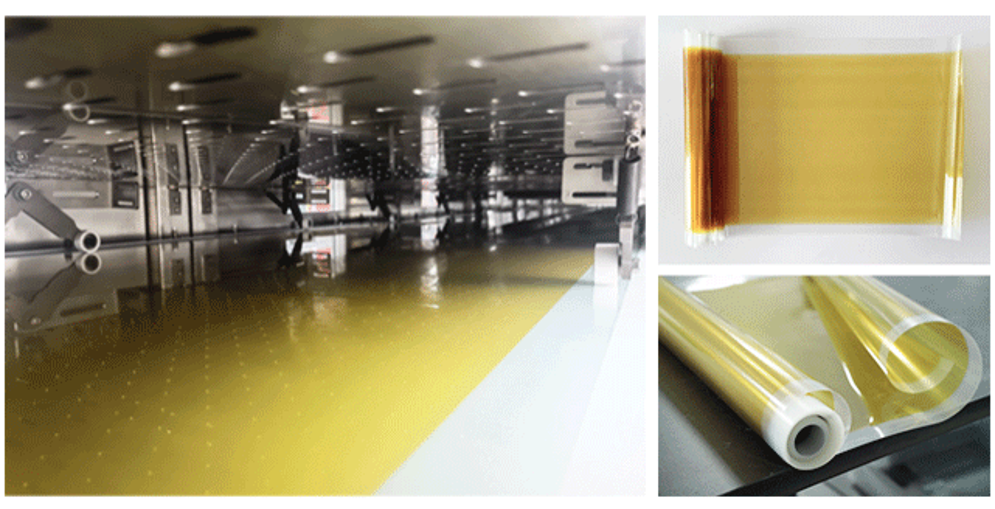
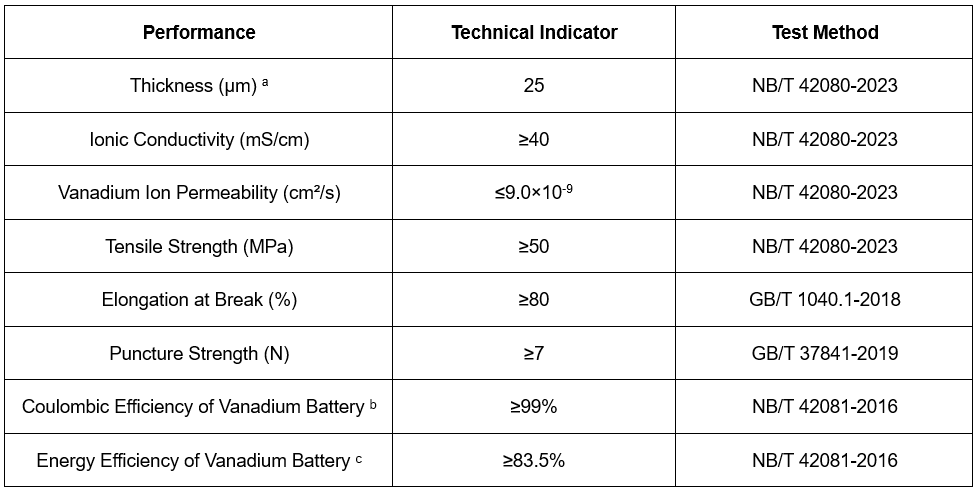
Test performance
Porimion®Performance comparison between flow battery membrane and perfluorosulfonic acid membrane in 1kW vanadium flow reactor:
| Power Density ( mW/cm² ) | Porimion® Membrane | PFSA Membrane 1 | PFSA Membrane 2 | ||||||
|---|---|---|---|---|---|---|---|---|---|
| CE(%) | VE(%) | EE(%) | CE(%) | VE(%) | EE(%) | CE(%) | VE(%) | EE(%) | |
| 120 | 99.6 | 88.9 | 88.5 | 96.2 | 87.8 | 84.4 | 95.6 | 88.4 | 84.6 |
| 150 | 99.7 | 86.6 | 86.1 | 96.0 | 85.1 | 81.7 | 95.8 | 85.6 | 82.0 |
| 180 | 99.6 | 83.9 | 83.5 | 96.2 | 82.4 | 79.2 | 96.0 | 82.8 | 79.5 |
| 210 | 99.6 | 82.3 | 82.0 | 96.2 | 80.7 | 77.6 | 96.0 | 82.7 | 77.5 |
| 240 | 99.6 | 81.3 | 81.0 | 96.2 | 79.0 | 76.0 | 96.1 | 78.7 | 75.7 |
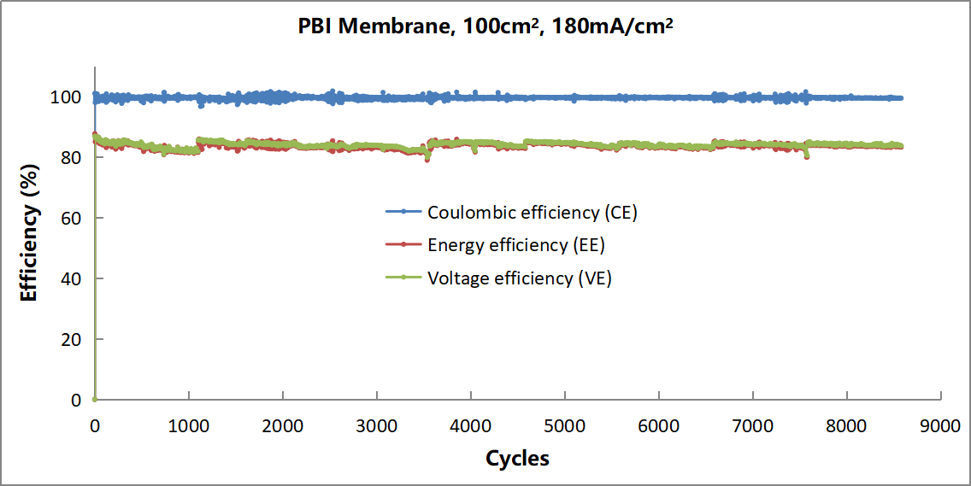
The 8000+ cycle test data of Porimion®PBI flow battery membrane in 20W vanadium flow battery: (180mA/cm2 running at constant current density, the single cycle time is about 1.5 hours. The performance degradation caused by vanadium ion migration can be restored to the initial state through mixed solution. )
The test data of Porimion®PBI flow battery membrane in a 1kW vanadium flow reactor with 5000 cycles: (When running at a constant power density of 240mW/cm2, the performance degradation caused by vanadium ion migration can be restored to the initial state by mixing the solution. )
Neutralization energy storage Porimion® high-density liquid flow battery membrane has been tested and applied by hundreds of customers at home and abroad, and some customers' real measured data have been received. See: Japanese customers' measured data: PBI liquid flow battery membrane energy efficiency is 85%, 600 Ma/cm does not decay, and PBI liquid flow battery membrane overseas stack measurement: EE 83.74%, CE 99.14%. We look forward to receiving more customers' measured feedback and case sharing.
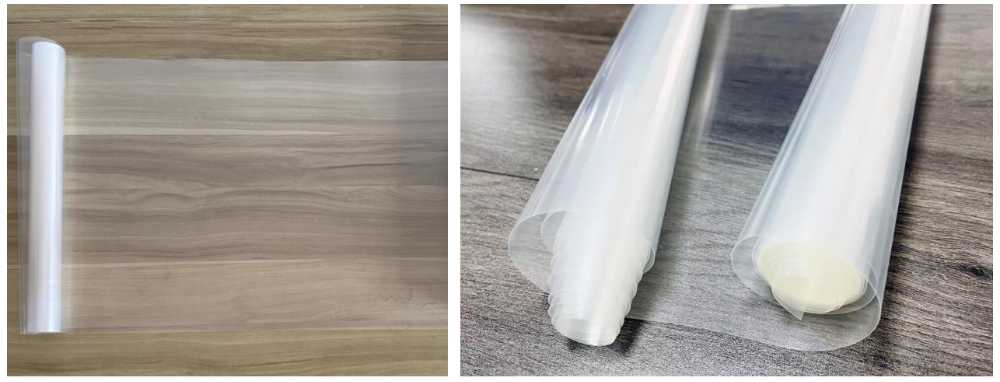
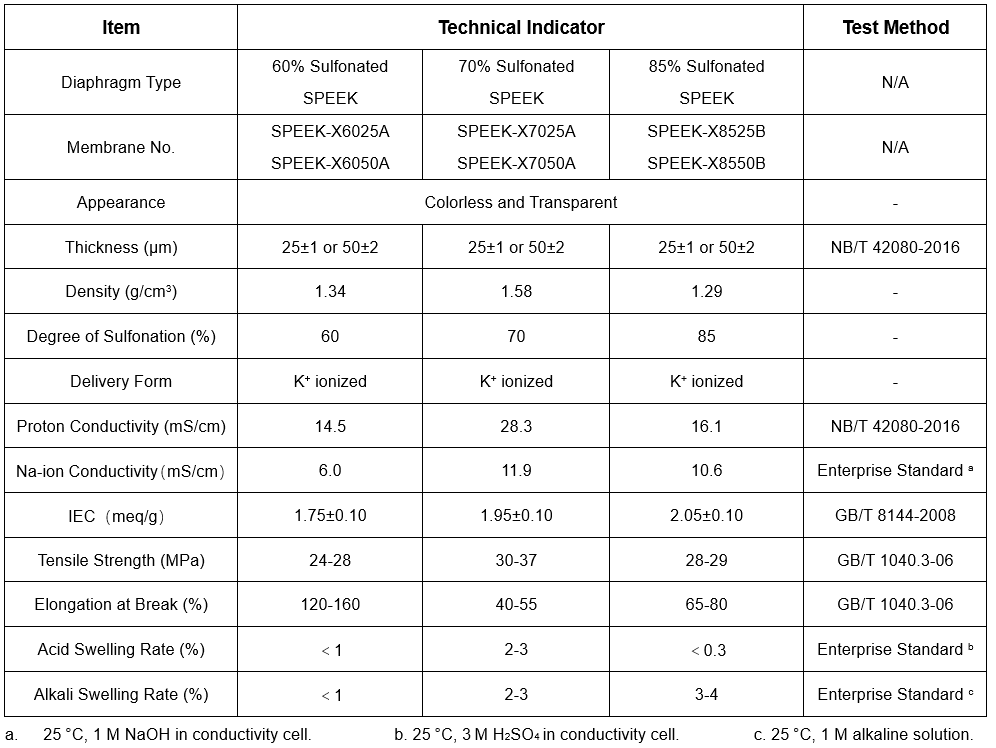
Sulfonated polyetheretherketone (SPEEK) membrane is a kind of high-performance non-fluorine ion exchange membrane prepared by sulfonation modification of the main chain of PEEK, which is specially designed for flow batteries. Sulfonated polyetheretherketone (PEEK) has a unique molecular structure, and its arrangement of ether bond, ketone bond and benzene ring makes it show special adaptability in the flow battery environment, and its swelling resistance is better than other non-fluorine ion exchange membranes, thus avoiding the performance degradation caused by swelling. The products are suitable for technical routes of flow batteries such as Zn-Mn, Zn-Br, Zn-Fe and total iron, and electrodialysis separation.
Product features
Performance balance:Low swelling, high mechanical strength, high chemical stability, and ion selectivity can be controlled by sulfonation degree.
Flexible customization:The sulfonation degree, thickness (15-75μm), and film width can be adjusted according to customer requirements, suitable for the design of flow battery systems in different applications.
Specification parameter
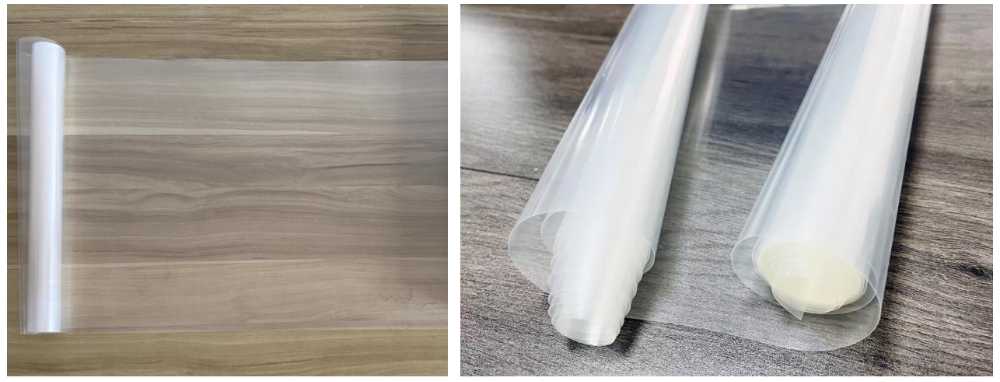
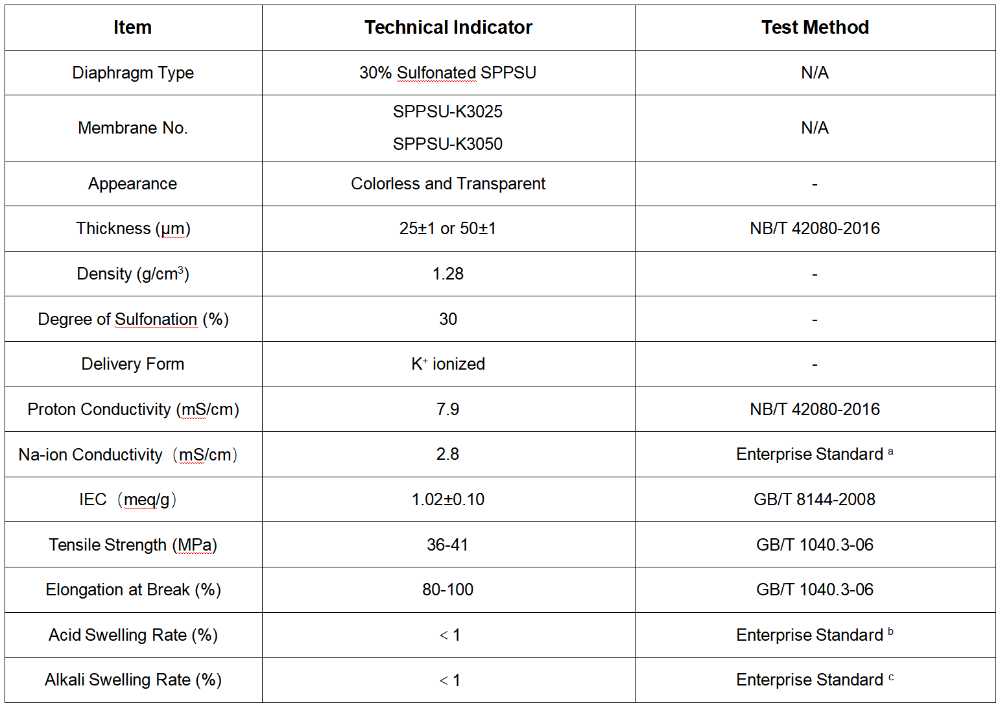
Sulfonated polyphenylene sulfone (SPPSU) flow battery membrane is a kind of high-performance non-fluorine ion exchange membrane based on sulfonated modification of the main chain of polyphenylene sulfone (PPSU), which is specially designed for flow battery and suitable for large-scale energy storage system. The membrane endows the PPS material with excellent ion selectivity and conductivity through sulfonation modification technology, which can effectively isolate the positive and negative electrolyte and realize the directional transmission of protons/ions, and ensure the energy conversion efficiency and cycle stability of the battery. Its unique chemical structure makes it show excellent durability under severe working conditions such as strong alkali, strong oxidation and high potential difference, and it is the core component of new flow battery to realize long life and low cost energy storage.
Product features
Low cost and high stability:Low cost, high mechanical strength, high chemical stability, ion selectivity and swelling ability can be controlled by sulfonation degree;
Flexible customization:The sulfonation degree, thickness (15-75μm) and membrane width can be adjusted according to customer's needs, so as to adapt to the design of flow battery system with different systems.
Specification parameter
| Product Series | Core Material | Preferred Compatible Systems | Core Highlights |
|---|---|---|---|
| Porimion® PBI Membrane | Polybenzimidazole | All-vanadium, Titanium-Bromine | Ultra-high vanadium barrier, high puncture resistance, high current density frequency regulation scenarios, Coulombic efficiency > 99% |
| SPEEK Membrane | Sulfonated Polyether Ether Ketone | Zinc-Manganese, Zinc-Bromine, Zinc-Iron, All-Iron, Electrodialysis | Anti-swelling, multiple sulfonation degrees available, compatible with zinc-based systems |
| SPPSU Membrane | Sulfonated Polyphenylsulfone | Zinc-based, Iron-based | Resistant to strong alkali and strong oxidation, high stability in harsh conditions, outstanding cost advantage |
Non-fluorine ion exchange membrane is not a simple concept, but a material scheme that can be supplied on a large scale after being measured by the stack. Different technical routes have their own advantages and disadvantages. Without a universal membrane, system matching is the first principle.