Global Progress of Iron–Sulfur Flow Batteries: Accelerating Technological Breakthroughs and a Growing Field of Entrants
Classification:Industrial News
- Author:ZH Energy Tech Team
- Release time:Feb-04-2026
【 Summary 】Iron–Sulfur batteries are accelerating toward engineering deployment and commercialization, with clear advantages in low cost and high safety.
As the global energy transition accelerates, installed capacity of renewable energy such as wind and solar continues to rise, driving an increasingly urgent demand for long-duration energy storage (LDES). Lithium-ion batteries face growing challenges in storage applications beyond 4–8 hours, including limited cost reduction potential and tightening safety constraints, prompting the industry to seek next-generation solutions better suited for mid- to long-duration storage.
Flow batteries, with their high safety, long cycle life, and decoupled power and energy capacity, are emerging as a key LDES technology. Among them, iron–sulfur flow batteries stand out as one of the most commercially promising pathways due to abundant raw materials, ultra-low cost, and high intrinsic safety.
Core Advantages of Iron–Sulfur Flow Batteries
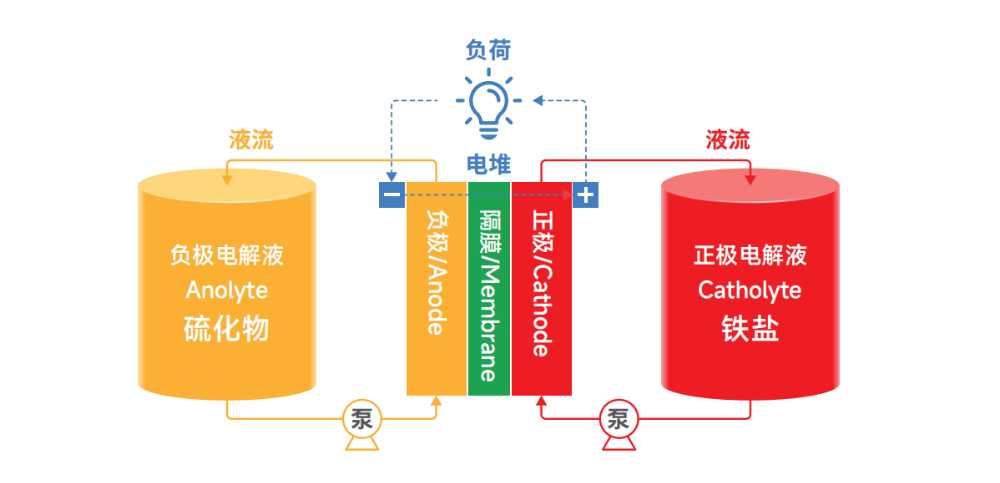
Compared with conventional vanadium-based systems, iron–sulfur electrolytes can reduce electrolyte costs by more than 85%, offering a strong economic advantage, particularly for large-scale grid applications. Key strengths include: fully liquid electrolytes on both electrodes, avoiding reliance on solid electrode materials; the use of earth-abundant iron (Fe) and sulfur (S), resulting in significantly lower material costs than all-vanadium and many other battery chemistries; aqueous electrolytes with no fire or explosion risk, greatly enhancing system safety; and structural decoupling of power and energy capacity through electrolyte volume, making the technology well suited for long-duration storage (6–24 hours and beyond).
Global R&D and Commercialization Progress
Driven by the dual advantages of low cost and high safety, iron–sulfur flow batteries have gained increasing global attention. Commercialization efforts are currently most advanced in China, where Zhonghe Energy Storage has achieved full value-chain breakthroughs from materials and stacks to system integration. The company has launched systems ranging from 100 kW to multi-megawatt scale, with stable operation demonstrated in multiple pilot projects, in collaboration with State Grid, Huaneng Clean Energy Research Institute, and academic institutions—placing it at the global forefront. Meanwhile, several Chinese universities and large industrial groups have initiated research into iron–sulfur systems.
Internationally, institutions such as the U.S. Pacific Northwest National Laboratory (PNNL) conducted early foundational research on iron–sulfur chemistry, validating its electrochemical stability and reversibility. Startups in regions such as India, including Tharam-Thiran, are beginning to explore iron–sulfur flow batteries for renewable-heavy energy systems. Although overseas deployment remains relatively slow, research and pilot projects are steadily increasing, highlighting the technology’s global potential.
Accelerating Engineering and Industrialization
As the flow battery supply chain matures—covering high-performance ion-exchange membranes, optimized electrolyte formulations, improved stack designs, and advanced system integration—the performance and cost competitiveness of iron–sulfur flow batteries continue to improve. Lower costs, higher efficiency, and enhanced operational stability are accelerating the transition from laboratory research to engineering demonstrations and early-scale deployment.
Future Outlook
Market forecasts indicate that the global flow battery market will grow rapidly from 2024 to 2032, reaching a scale of tens of billions of dollars, creating substantial opportunities for iron–sulfur commercialization. Continued advances in electrolytes, catalysts, and system integration are expected to further improve current density and round-trip efficiency. As demonstration projects expand and standardized modules and supply chains mature, system costs will decline further. Policy support for clean energy and LDES across multiple regions will also provide strong tailwinds. Beyond grid-scale storage, growing demand from microgrids, industrial parks, and off-grid applications will broaden deployment scenarios. Overall, iron–sulfur flow batteries are moving from laboratory research toward accelerated engineering and commercialization, and are poised to become one of the most promising and scalable technologies for future long-duration energy storage.