Engineering Bottlenecks in Organic Flow Batteries: Electrolyte Corrosion and Oxygen Sensitivity
Classification:Industrial News
- Author:ZH Energy Tech Team
- Release time:Jul-03-2026
【 Summary 】The performance gap between laboratory-scale testing and stack stability usually lies at the system level.
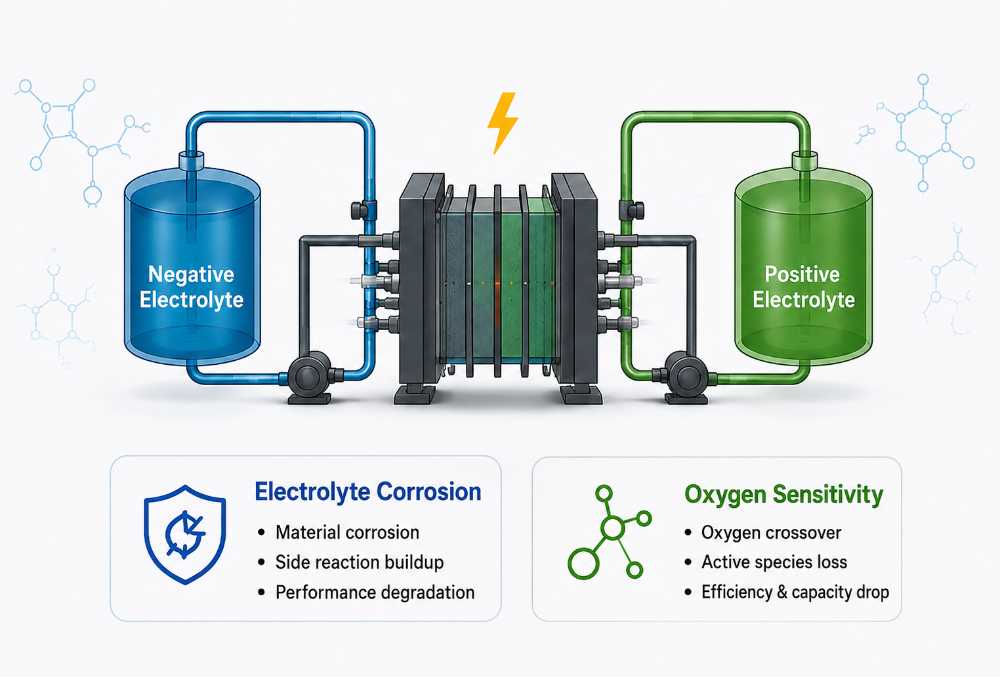
In the development of organic flow batteries, a common phenomenon is that single-cell performance appears stable, while stack-scale performance degrades rapidly. Industry experience suggests that this issue is not primarily driven by molecular design, but by two system-level engineering factors: long-term compatibility between electrolyte and materials (corrosion behavior), and oxygen ingress–induced side reactions. These effects are often negligible under laboratory conditions but become significantly amplified at stack scale.
At the lab scale, organic flow systems typically operate under ideal conditions, including high-purity electrolytes, inert atmospheres, and short cycling durations. Research therefore focuses on molecular reversibility, cycle life, and electrochemical efficiency, while long-term material compatibility is often overlooked.
However, at stack or pilot scale, the situation changes. Trace impurities in industrial electrolytes (e.g., metal and halide ions) can participate in interfacial side reactions under long-term cycling and high potentials. Meanwhile, sealing components, flow fields, pumps, and tubing are continuously exposed to electrolyte and dynamic operation, leading to cumulative degradation.
This degradation is rarely sudden failure. It typically manifests as increased internal resistance, declining energy efficiency, and gradual capacity fade. In practice, the same electrolyte system can show significantly different lifetimes depending on material selection, highlighting that the key issue is system-level material compatibility rather than any single component.
Compared with corrosion, oxygen sensitivity is more hidden and often underestimated in early-stage development. Many organic redox-active species, especially reduced radical forms, are highly reactive with oxygen. Even trace dissolved oxygen can rapidly cause irreversible loss of active species.
In single-cell lab testing, this issue is usually minimal due to inert or low-oxygen conditions. However, in stack systems, oxygen ingress occurs through multiple continuous pathways, including minor leaks in pumps and tubing, tank breathing effects, and gas–liquid exchange during system start-up and shutdown. This makes oxygen exposure a long-term, low-rate accumulation process rather than a one-time event.
The result is typically reduced coulombic efficiency and gradual capacity decay, while the electrochemical reaction itself may still appear normal. This explains why many systems perform well in the lab but deviate significantly at engineering scale.
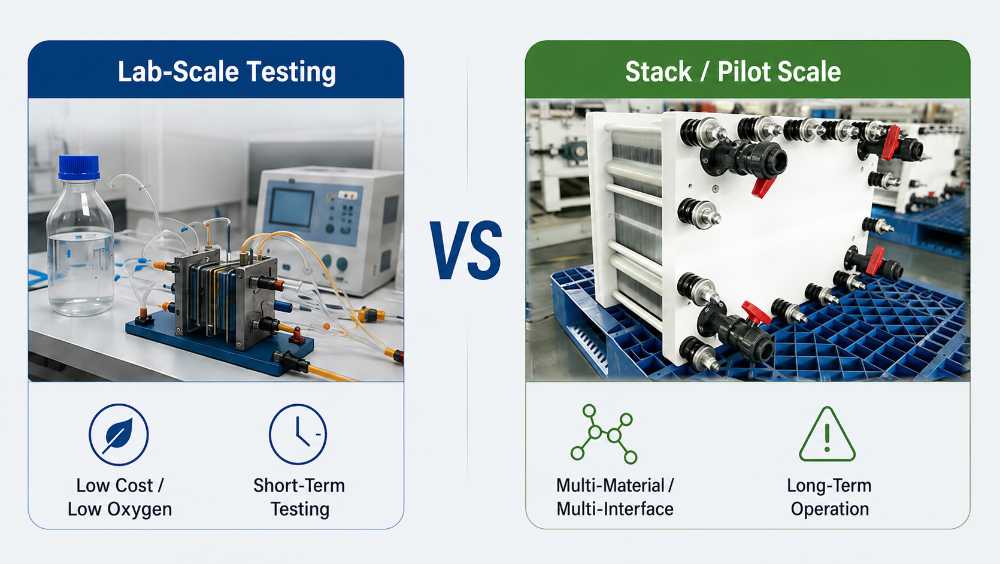
Transitioning from lab to stack is not about increased complexity, but about previously hidden variables becoming dominant. Trace impurities, long-term material corrosion, and oxygen permeation collectively drive failure mechanisms at scale.
As a result, more R&D teams are shifting from single-parameter testing to system-level reliability validation. In addition to electrochemical metrics, early-stage evaluation increasingly includes accelerated aging tests, material compatibility studies, oxygen control strategies, and long-duration operational verification to expose failure modes earlier and reduce scale-up risk.
Overall, organic flow batteries are evolving from a molecular design–driven field toward a systems engineering–driven discipline. What will determine commercial viability is no longer only material performance, but long-term stability and verifiable reliability under real operating conditions.
Over the past year, we have delivered multiple organic flow battery testing systems and stack platforms supporting R&D and pilot projects worldwide. Field experience shows that while technical routes differ, challenges around electrolyte corrosion, oxygen sensitivity, and system reliability are highly universal. We look forward to collaborating with more teams to develop more effective testing and validation frameworks, accelerating the transition of organic flow batteries from laboratory research to engineering deployment.