Beyond Energy Storage: How Flow Cell Stacks Solve Scale-Up Challenges in CO₂ Electrolysis
Classification:Industrial News
- Author:ZH Energy Tech Team
- Release time:Jul-29-2026
【 Summary 】This paper unpacks the technical rationale of this cross-field application across stack design, flow field optimization and large-area manufacturing. Know-how in flow battery stack production forms a vital foundation for overcoming CO₂ electrolysis scale-up barriers.
Tens of thousands of research papers have been published, yet industrial stacks remain extremely scarce. In the field of electrochemical CO₂ reduction, the Web of Science indexes over 20,000 publications. Research on catalysts, membrane materials and reaction mechanisms grows exponentially each year. Globally, however, very few industrial-grade stack systems achieve kilowatt-level output and continuous operation beyond 1,000 hours.
The bottleneck lies not in inadequate catalysts, but insufficient stack engineering. Stack engineering has become the "last-mile" barrier to the commercialization of CO₂ electrolysis — and this exact challenge is where the flow battery industry boasts decades of accumulated core expertise.

Global carbon targets position CCUS as vital climate technology. CCU—turning captured CO₂ into high-value chemicals and fuels—stands out for its waste-to-value model, attracting wide industrial and academic attention.
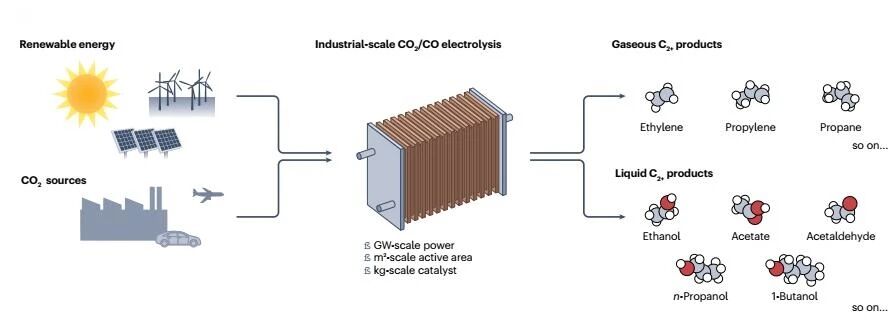
Fundamental CO₂ reduction chemistry is fully proven; all commercialization bottlenecks stem from scale-up.
Three key pain points:
0.033 mol/L: Low atmospheric CO₂ water solubility limits high current densities in liquid systems, mandating GDEs to feed gaseous CO₂ straight to catalysts.
100× scaling: Electrodes expand from cm² to hundreds of cm², spurring exponential issues of uneven current, hotspots and seal breakdowns.
Thousands of runtime hours: Lab tests run ~20 hours, but 2,000-hour industrial operation causes carbonate buildup, membrane degradation and catalyst poisoning, triggering sharp performance drops.
Simply put, the core challenge is stable, high-efficiency operation on large electrode areas, not the reaction itself.The mainstream industrial route combines GDEs and MEAs inside stack hardware, a design intrinsically related to flow battery stacks.
Decades of commercialization have equipped vanadium flow batteries with a full-stack engineering system covering design, manufacturing, testing and mass production. Most of these proven engineering capabilities are transferable to CO₂ electrolysis stack development.
Strength 1: Highly Compatible Stack Architecture
Flow battery core components, including end plates, current collectors, bipolar plates, electrodes and ion exchange membranes, share nearly identical structural frameworks with CO₂ electrolysis stacks, supporting rapid platform reuse with targeted component upgrades. The two technologies differ only in operating conditions. Flow batteries adopt pure liquid-phase reactions, whereas CO₂ electrolysis involves complex gas-liquid-solid three-phase coupling, accompanied by dynamic pH variation, carbonate by-products and gas generation. Though this raises higher requirements for sealing, anti-clogging performance and membrane chemical stability, the basic stack structural design remains fully reusable.
Strength 2: Mature Flow Field Engineering Expertise
Often overlooked, flow field design is pivotal to stack performance. Serpentine, interdigitated and parallel flow fields precisely control reactant distribution, pressure drop and mass transfer efficiency. The flow battery industry has accumulated decades of experience in single-phase flow simulation and multi-physics field optimization via repeated iteration and verification. Despite more complex gas-liquid two-phase conditions in CO₂ electrolysis, the core methodology for uniform flow distribution is universally applicable.
Strength 3: Precise Large-Area Manufacturing Consistency
Stack performance heavily relies on three key indicators: uniform sealing compression, bipolar plate flatness and stable electrode-membrane contact, where tiny deviations lead to significant performance loss. The mature process windows, inspection standards and quality control systems for large-area flow battery stacks can be directly applied to CO₂ electrolysis mass production. This scalable manufacturing capability is a core technical barrier that new entrants struggle to break through in a short time.
Flow battery engineering expertise can be reused but cannot be directly duplicated for CO₂ electrolysis. This technology faces four unique engineering challenges that require targeted technical iteration based on mature flow battery stack experience.
Challenge 1: Gas-Liquid Two-Phase Flow Management
This is the core technical difference between CO₂ electrolysis and flow batteries. CO₂ electrolysis requires co-distribution of gaseous reactants and liquid electrolyte in one flow field. Excessive gas flow dries out the catalytic layer and deactivates catalysts, while excessive electrolyte flow blocks CO₂ diffusion to active sites. The narrow adjustable operating window is a key bottleneck for stack scaling.
Core Solution: Adopt segmented flow fields and gradient-porosity diffusion layers to realize independent gas-liquid transport. Collaboratively optimize gas/liquid flow rate, backpressure and temperature to build a stable and reliable operational window.
Challenge 2: Catalyst Layer Engineering Integration
High-performance lab-scale catalyst coatings often suffer from poor uniformity, weak adhesion and active material detachment after scaling up to industrial large-area electrodes. The scale-up from cm² to hundreds of cm² is not a simple size expansion, but a systemic engineering upgrade covering slurry rheology, coating and drying processes.
Core Solution: Leverage flow battery large-area manufacturing experience to achieve seamless scale-up from lab blade coating to industrial roll coating, and establish quantitative correlations between slurry properties, coating parameters and electrode performance.
Challenge 3: Long-Term Operational Stability
Long-run CO₂ electrolysis suffers from continuous performance degradation caused by carbonate crystallization and flow channel clogging, alkaline-induced membrane degradation, and trace-impurity catalyst poisoning. Comprehensive optimization of materials, structure and operation is essential.
Core Solution: Adopt a three-pronged optimization strategy: corrosion-resistant bipolar plates and high-stability membranes at the material level; anti-crystallization flow channels and drainage designs at the structural level; regular flushing, pH adjustment and electrochemical regeneration at the operational level. Meanwhile, build supporting degradation diagnosis and service life prediction systems.
Challenge 4: Cost-Efficiency Balance
The economic feasibility of CO₂ electrolysis depends largely on current density and energy efficiency. Raising current density while maintaining high Faradaic efficiency is critical to reducing unit production costs, which is limited by stack mass transfer performance and ohmic resistance.
Core Solution: Reduce overall ohmic loss through stack structural optimization, including low-resistance bipolar plates, optimized compression distribution and thinned membrane electrode assemblies. This effectively boosts current density and energy efficiency without significant material cost growth.
The International Energy Agency (IEA) identifies electrochemical CO₂ utilization as one of the high-potential pathways within the CCU technology portfolio. With falling renewable power prices and maturing carbon pricing frameworks, the economic tipping point for CO₂ electrolysis is approaching faster than anticipated.
Nevertheless, for real-world deployment, catalyst innovations define the theoretical performance ceiling, while stack engineering maturity governs the pace of commercial rollout.
The cross-sector expansion of flow battery stack technology is far more than experimental testing in a new application. It represents the natural extension of proven stack engineering methodologies across a broader spectrum of electrochemical technologies.
From energy storage to carbon utilization, the fundamental principles remain unchanged: efficient mass transfer, uniform reactant distribution, robust sealing and stable long-duration operation. Regardless of reaction systems, these engineering fundamentals form the bedrock for scaling electrochemical devices from laboratory prototypes to industrial production.
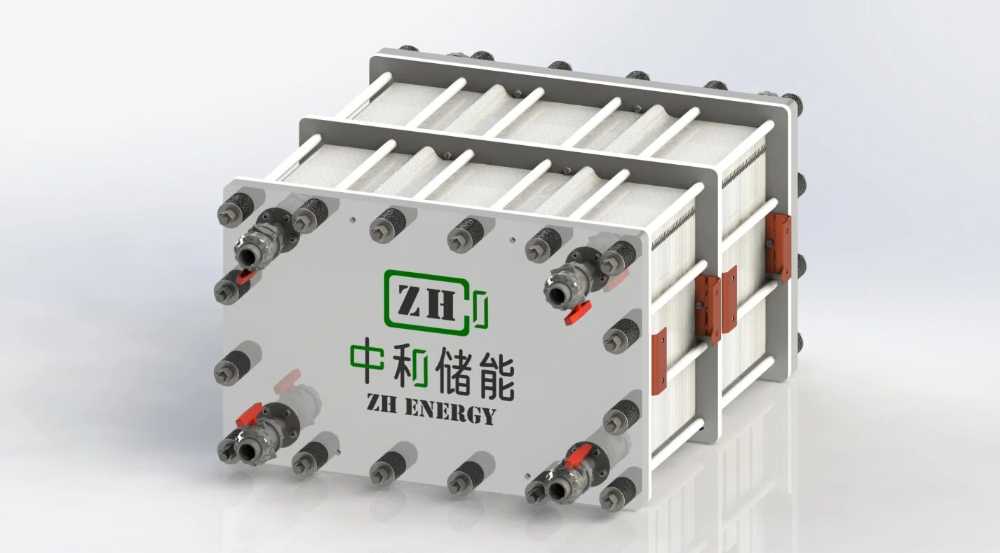
We will continue advancing stack engineering technologies and look forward to exploring broader opportunities in electrochemistry alongside industry partners.If you are developing stacks for CO₂ electrolysis or other electrochemical applications, we welcome technical exchanges. Drawing on our mature stack engineering capabilities, we stand ready to accelerate the commercial translation of your technologies from lab to market.