New Article by Client Published in a Nature Sub-journal: Open-Loop Flow Battery
Classification:Industrial News
- Author:ZH Energy Tech Team
- Release time:Aug-14-2026
【 Summary 】Flow batteries function as chemical factories, delivering energy-storage while producing hydrogen and glycolic acid, and attaining a record first levelized cost of electricity (LCOE) of -$0.26 per kWh.
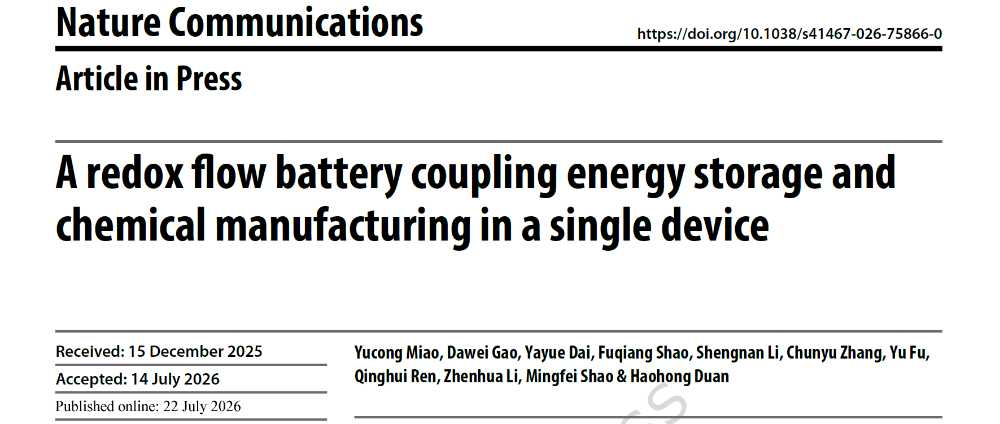
In July 2026, a joint team from Beijing University of Chemical Technology and Tsinghua University published a breakthrough study in Nature Communications on Open-Loop Flow Battery (OLFB). Departing from the fully closed-loop circulation of conventional flow batteries, it breaks the industry bottleneck where revenue solely relies on peak-valley price arbitrage. A single device delivers energy storage while co-producing green hydrogen and high-value chemicals, opening a brand new profit avenue for long-duration energy storage.
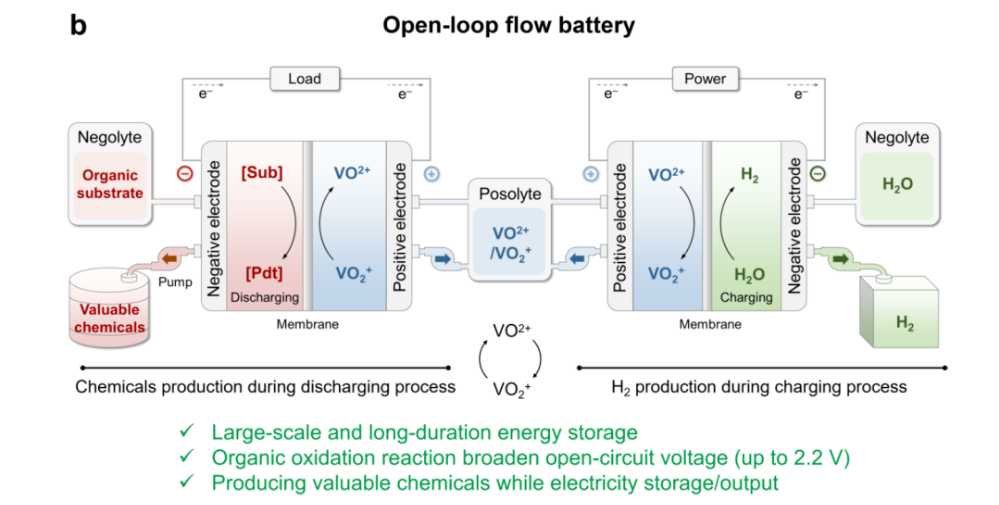
Conventional flow batteries operate via closed‑loop reversible electrolyte circulation, with functions limited solely to energy charging and discharging. Project revenue depends on grid peak‑valley price arbitrage, resulting in long investment payback periods.
Conventional batteries: Cathode and anode electrolytes circulate in a fully sealed loop with reversible reactions and no by‑product generation.
OLFB: Reconstructs the pairing logic of electrochemical reactions. The two sets of reactions are completely separated with unidirectional material flow; electrolyte recirculation is eliminated. Energy storage is deeply coupled with chemical synthesis.
Charging (surplus power from PV/wind): Vanadium‑ion oxidation coupled with water electrolysis for green hydrogen production.Discharging (peak‑demand hours): Vanadium‑ion reduction coupled with oxidation of organic feedstocks to synthesize high‑value fine chemicals such as glycolic acid.
The team conducted tests using ethylene‑glycol‑to‑glycolic‑acid as the model system:
Open‑circuit voltage: 1.6–1.9 V; peak power density: 238.4 mW/cm²
Thermodynamic potential gain from organic‑substrate oxidation yields voltage and energy efficiency ≥100%
Stable performance over 200 long‑term cycles; per‑cycle capacity decay <0.013%
Broad compatibility: compatible with 13 types of organic substrates and mainstream cathode redox couples including vanadium, iron, ferricyanide and TEMPO, demonstrating massive general‑application potential.
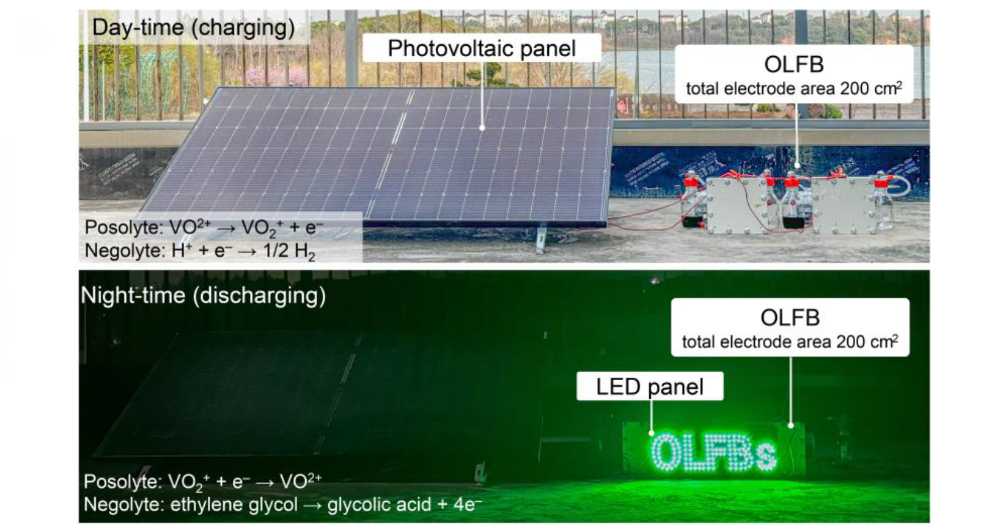
The research team built a PV‑integrated pilot setup simulating daytime energy storage and nighttime power supply for wind‑solar power stations. It ran stably for 10 consecutive days:
Total exported electricity: 948.6 Wh
532.2 g of glycolic acid at 97.2% high purity
Co‑produced 272.9 L of high‑purity green hydrogen
This successfully validates the practical feasibility of an integrated solution: on‑site renewable‑energy utilization, green‑hydrogen production and low‑carbon chemical manufacturing.
The OLFB validation platform was built upon our company’s standardized flow‑battery hardware. The equipment supports full‑system electrolytes including vanadium and TEMPO as well as iron‑based chemistries. It delivers stable output across a wide current range and enables top‑journal‑grade long‑cycle electrochemical validation, providing reliable hardware support for this co‑generation test.
Techno‑economic analysis delivers striking results: the levelized cost of electricity (LCOE) of the OLFB system reaches ‑$0.26/kWh. The negative value means the system generates an extra $0.26 of revenue for every 1 kWh discharged. Revenues from chemicals and hydrogen fully offset all capital and O&M costs for energy storage, breaking away from the old paradigm where energy storage acts purely as a cost center.
OLFB fully inherits three intrinsic merits of flow batteries: inherent safety, decoupled power‑capacity design and ultra‑long cycle life. One single system addresses three critical industrial demands:
Grid integration and consumption of wind‑solar renewable energy
Low‑cost large‑scale green‑hydrogen production
Low‑carbon transformation for fine‑chemical industries
This creates a brand‑new business model of “energy storage coupled with co‑generation of chemicals”.
Although OLFB still faces engineering challenges including product‑separation processes and multi‑substrate catalytic optimization, its underlying innovation carries strong practical‑implementation value. Rather than treating energy storage merely as a cost item, it functions as a comprehensive electrochemical platform for power regulation plus green chemical synthesis. Against the backdrop of the new‑type power system and carbon‑neutrality goals, this novel coupling route of energy storage and electrochemical synthesis is poised to become a highly competitive direction within the long‑duration energy‑storage (LDES) sector.
Literature Citation: Miao Y, et al. A redox flow battery coupling energy storage and chemical manufacturing in a single device [J]. Nature Communications, 2026, https://doi.org/10.1038/s41467-026-75866-0