CAS Nature Publication: How to Solve Three Major Pain Points of Vanadium Redox Flow Batteries?
Classification:Industrial News
- Author:ZH Energy Tech Team
- Release time:Aug-27-2026
【 Summary 】3 μm membrane, 30 % higher electrolyte energy density, doubled stack power — decoding the path toward large‑scale vanadium‑battery deployment. An interpretation of the industry perspective article published in *Nature Energy*.
There is a well‑acknowledged consensus in the energy‑storage sector: lithium‑ion batteries excel at short‑duration applications, while vanadium flow batteries dominate long‑duration scenarios. As wind and solar penetration keep rising, power grids demand far more than 2‑hour emergency backup. They require sustained discharge of 6 hours or longer — this is where Long‑Duration Energy Storage (LDES) delivers its value, and where vanadium redox flow batteries (VRFBs) shine.
Nevertheless, large‑scale rollout faces substantial hurdles. Low power density, poor high‑temperature stability of electrolytes and high system costs, compounded by considerable auxiliary power consumption, have long confined VRFBs to demonstration projects.
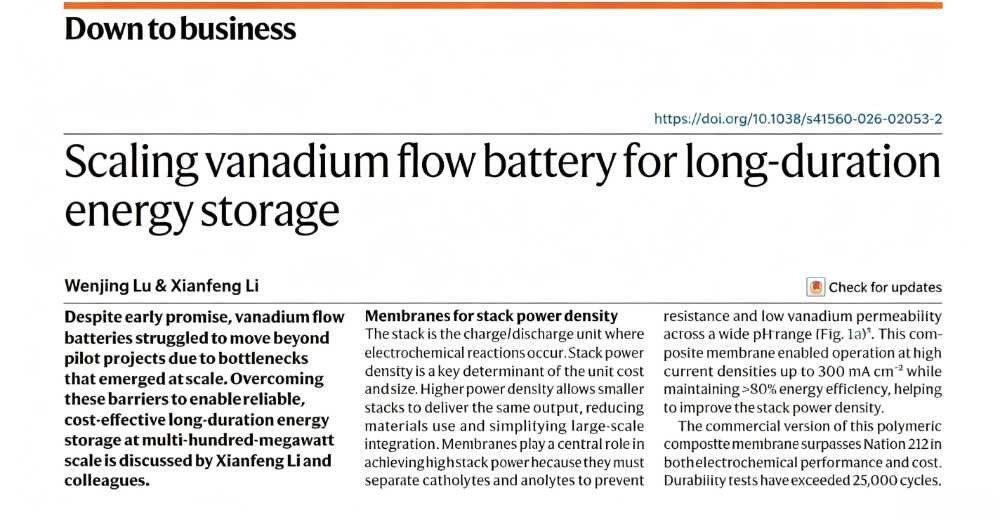
Recently, Nature Energy (a Nature‑branded energy journal) published a review article led by the research team of Prof. Li Xianfeng from the Dalian Institute of Chemical Physics, Chinese Academy of Sciences (CAS). Titled Vanadium redox flow batteries for large‑scale long‑duration energy‑storage applications, the paper systematically outlines the full‑chain progress of VRFBs from material breakthroughs to grid‑scale deployment. The core solutions lie in three key components: membranes, stacks and electrolytes.
The membrane functions as the “heart” of a battery stack: it must enable proton transport while blocking vanadium‑ion crossover, presenting an inherent engineering dilemma.
Early‑generation perfluorosulfonic‑acid membranes (e.g., Nafion) feature excellent proton conductivity, yet cost over USD 700 per square metre and suffer from insufficient ion selectivity, leading to capacity fade. Alternative non‑fluorinated membranes come with lower cost but are vulnerable to degradation under strongly oxidising operating conditions.
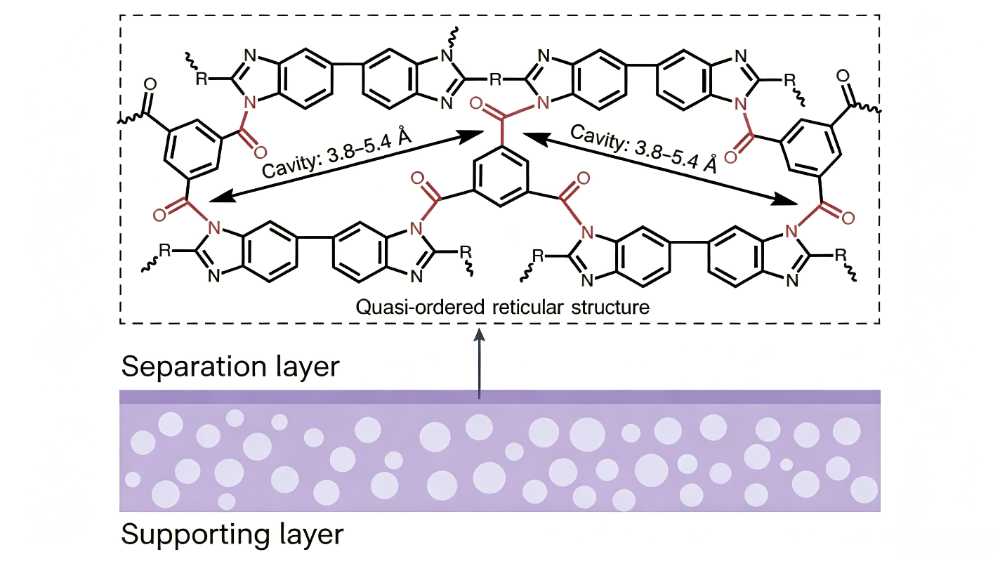
The breakthrough leverages size‑sieving effects. Hydrated vanadium ions have a diameter of ~0.8 nm, versus merely ~0.41 nm for hydrated protons. Exploiting this intrinsic size difference, the team developed an asymmetric composite membrane: a porous supporting substrate integrated with an ultra‑thin separating layer fabricated via interfacial polymerisation. The resulting self‑standing membrane is only 3 μm thick, with pore sizes tuned between 3.8–5.4 Å. This pore‑size window permits unimpeded proton conduction while suppressing vanadium‑ion permeation, breaking the long‑standing trade‑off between conductivity and selectivity.
Practically, the membrane maintains energy efficiency above 80 % at 300 mA/cm² and delivers durability exceeding 25 000 cycles, alongside drastically reduced material costs. It lays a solid material foundation for high‑power VRFB stacks.
Membranes govern ion transport; flow‑fields govern flow uniformity. Conventional flow‑fields easily generate stagnant dead zones around channel corners, causing uneven electrolyte distribution and severe concentration polarisation.
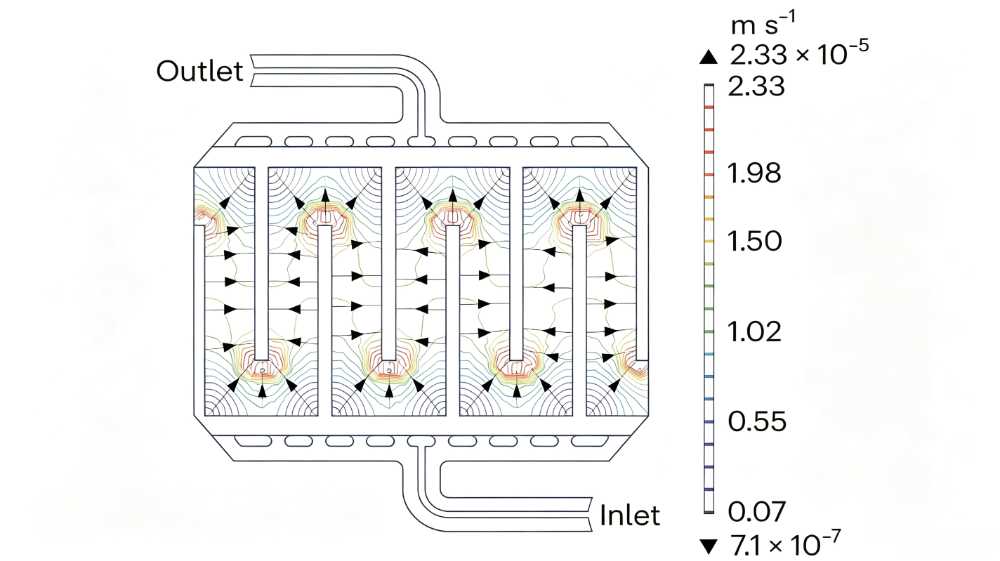
Guided by 3D numerical simulation to optimise electrolyte routing, the team proposed trapezoidal flow‑field architecture. The channel cross‑section gradually narrows along the flow direction, increasing flow velocity from inlet to outlet. This eliminates stagnant dead zones and achieves homogeneous electrolyte distribution. Combined with ultra‑thin electrodes to shorten electron‑transport pathways, polarisation losses are further mitigated.
Stacks equipped with trapezoidal flow‑fields achieve doubled power density compared with legacy designs, together with reduced costs and compatibility with automated mass manufacturing.
The electrolyte acts as the energy “fuel reservoir”. Its concentration and volume directly determine system capacity and constitute a major cost fraction. Traditional VRFB electrolytes have two critical limitations: low energy density, and precipitation of V₂O₅ from hydrated VO₂⁺ ions above 50 °C, which triggers voltage spikes and even stack failure.
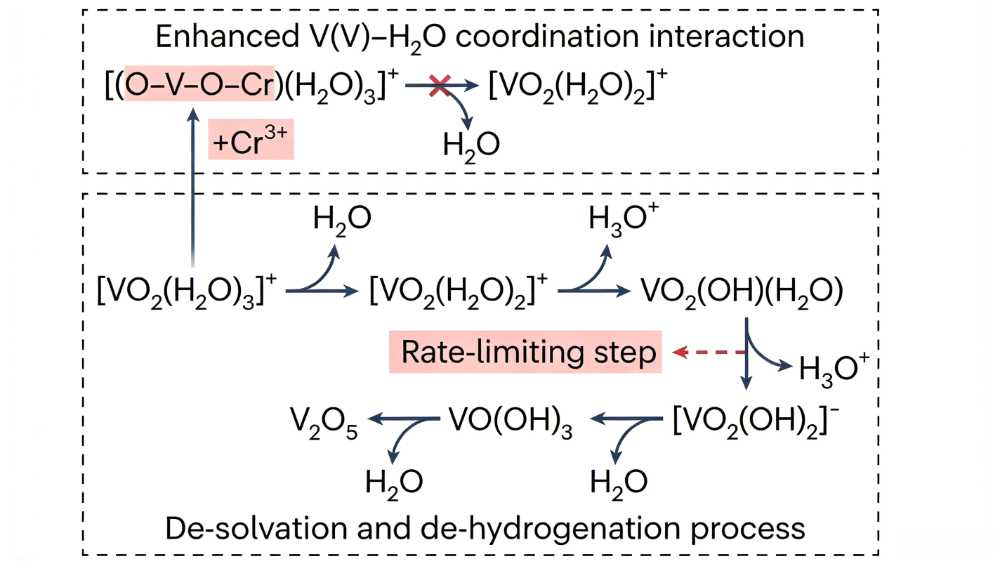
The team uncovered the underlying mechanism: hydrated VO₂⁺ ions undergo V₂O₅ precipitation through a four‑step desolvation and dehydrogenation reaction, where proton dissociation in the second step is the rate‑limiting process. The mitigation strategy relies on cation‑anion coordination: introducing coordinating ions such as Cr³⁺ to form coordination complexes with vanadyl ions, stabilising the vulnerable ionic species.
This approach effectively broadens the thermal‑stability window. The active‑species concentration rises from 1.6 mol/L to 2.0 mol/L, delivering approximately 30 % improvement in energy density and enabling stable operation over a wider temperature range.
Further technical advances are still required for widespread large‑scale VRFB deployment:
Membranes: Simultaneously enhance proton conductivity and vanadium‑ion rejection, and mitigate self‑discharge during long‑term cycling.
Electrolytes: Improve stability and energy density. Emphasis should be placed on multi‑component interfacial coupling rather than single‑parameter optimisation, balancing performance, durability and cost.
Stack architecture: Advance integrated flow‑field‑electrode design to enhance mass‑ and heat‑transfer and boost electrochemical reaction efficiency.
Beyond material and structural innovation, business‑model innovations such as electrolyte leasing, together with AI‑assisted material screening and system operation‑maintenance, will accelerate industrial adoption of VRFBs and deliver reliable long‑duration energy‑storage solutions for the new‑type power system.