8000+ Cycle Stability: PBI Membrane Solves VRFB Non-Fluorine Degradation
Classification:Company News
- Author:ZH Energy Tech Team
- Release time:Aug-18-2026
【 Summary 】The PBI membrane delivers stable performance over 8000+ cycles with Coulombic efficiency maintained at 99.6%. Suitable for high‑power‑density stacks, flow battery frequency regulation, and vanadium electrolyte redox production.
The strong oxidizing property of pentavalent vanadium cation (VO₂⁺) at the positive electrode has long posed the greatest challenge to separators for vanadium redox flow batteries (VRFBs). Perfluorinated membranes feature outstanding oxidation‑resistance stability, yet they suffer from high cost, poor degradability, severe vanadium‑ion crossover and high self‑discharge loss, making them far from the optimal choice for VRFB applications.
Conventional non‑fluorine separators are cost‑effective, but they are prone to oxidative degradation in high‑valent vanadium electrolytes. After several thousand cycles, separator cracking and severe vanadium‑ion crossover commonly occur, triggering sharp efficiency drop and greatly shortened stack service life.
To address the long‑term stability bottleneck of non‑fluorine membranes in vanadium electrolytes, polybenzimidazole (PBI) ion‑exchange membranes stand out as one of the most promising candidates for two key reasons. First, the rigid aromatic molecular backbone delivers exceptional resistance against oxidative degradation induced by vanadium ions. Second, intrinsic imidazole rings along the polymer backbone serve as ion‑exchange sites. There is no need to introduce large amounts of sulfonated side‑chains to boost ionic conductivity, which would otherwise compromise backbone structural stability.
Zhenergy Porimion® PBI high‑power‑density flow‑battery membrane is developed under such technical background. In‑house testing has validated its long‑term anti‑oxidation stability with over 8000 cycles, breaking the lifetime limitation of conventional non‑fluorine membranes. It is compatible with acidic flow‑battery systems including vanadium redox and titanium‑bromine flow batteries.
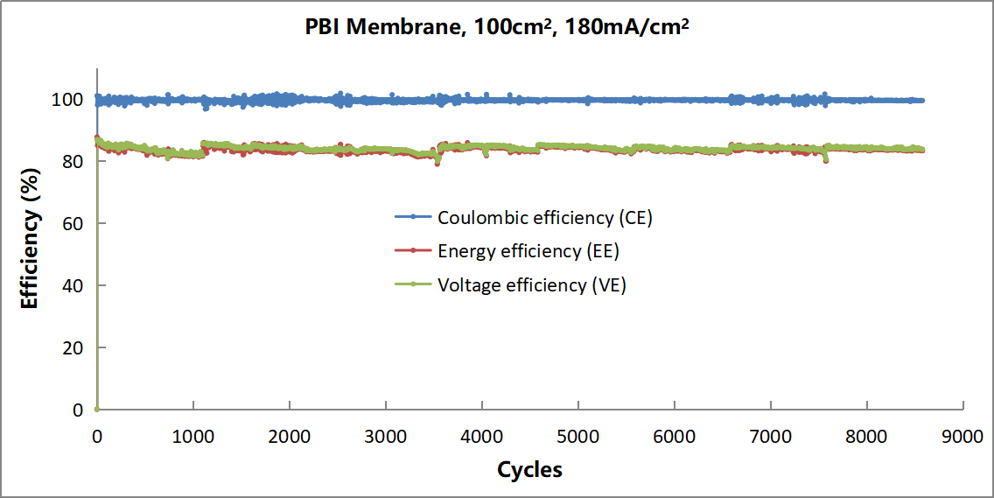
Tested on an in‑house 20 W VRFB cell with an active area of 100 cm², the PBI membrane has completed more than 8000 continuous charge‑discharge cycles at a constant current density of 180 mA/cm². Each cycle lasts 1.5 hours, corresponding to an accumulated runtime of approximately 1.5 years. The coulombic efficiency remains stably above 99.6 % throughout the test, with no obvious decay in voltage and energy efficiency. No performance degradation is observed from oxidative erosion. Minor performance fluctuations caused by vanadium‑ion and water crossover can be restored to initial levels via electrolyte remixing and vanadium valence adjustment. The cell is still running and targeting the 10 000‑cycle milestone.
Previously released 1 kW stack data further validates such performance: the PBI membrane maintains stable performance without degradation after 5000 cycles under a constant power density of 240 mW/cm².
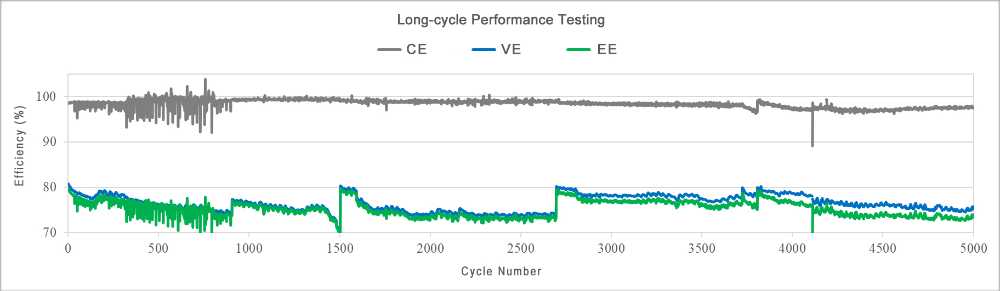
Tests at two distinct scales and operating conditions draw a consistent conclusion: the Porimion® PBI membrane can sustain long‑term operation under the harsh strongly oxidizing environment of pentavalent vanadium.
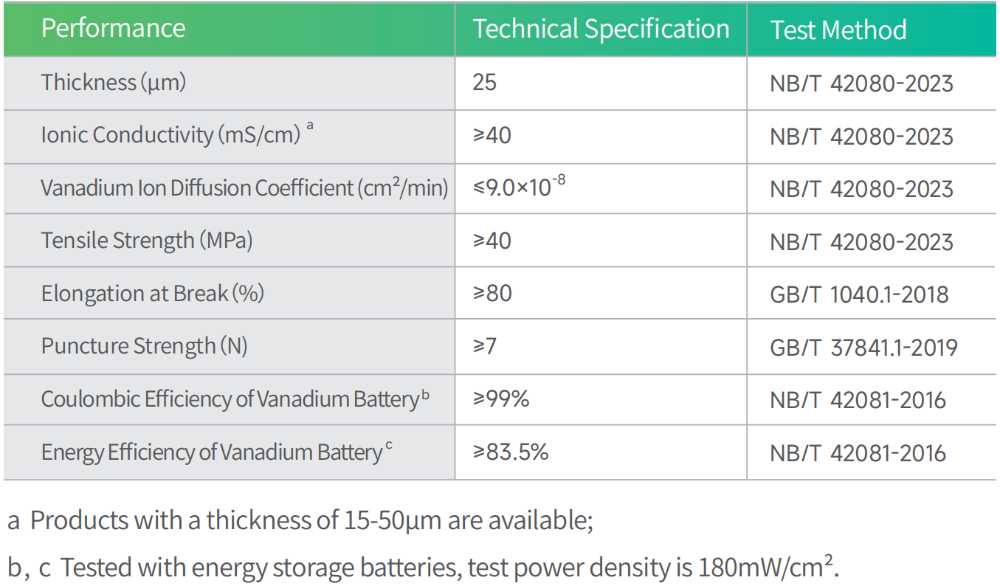
The oxidation‑resistant backbone prevents polymer molecular‑weight decline and separator cracking, preserving long‑term ion‑sieving capability. Porimion® membrane achieves vanadium‑ion crossover rate ≤ 9.0 × 10⁻⁸ cm²/min, one order of magnitude lower than conventional perfluorosulfonic acid membranes, which effectively suppresses self‑discharge.
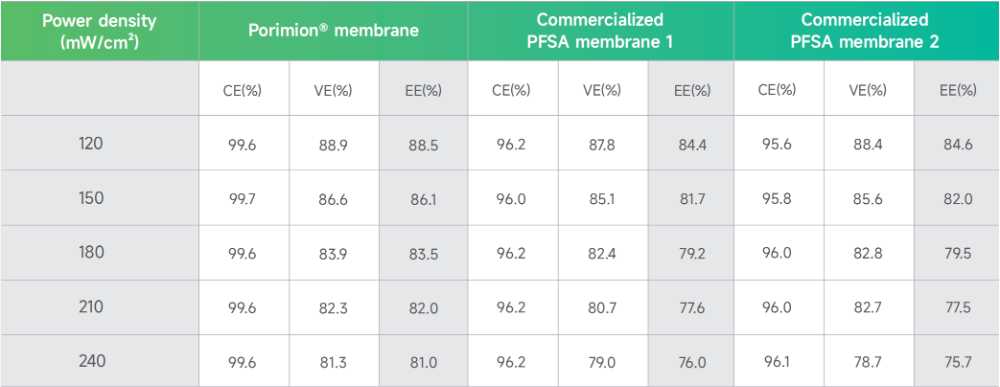
Standard condition @180 mW/cm²: Coulombic efficiency 99.6 %, energy efficiency 83.5 %
High‑power condition @240 mW/cm²: Coulombic efficiency remains 99.6 %, energy efficiency reaches 81.0 %
Efficiencies across the full power range outperform commercial perfluorinated membranes, substantially cutting round‑trip energy loss for energy‑storage power stations. It is particularly suitable for high‑power‑density stacks, flow‑battery frequency regulation, and redox production of vanadium electrolytes.
The rigid backbone constructed by benzene and imidazole rings endows PBI membranes with excellent mechanical properties. Even at a thin thickness of merely 25 μm, the membrane delivers mechanical performance comparable to 50 μm‑thick perfluorinated membranes: tensile strength ≥ 40 MPa, puncture strength ≥ 7 N, and elongation at break ≥ 80 %. It resists puncture from graphite‑electrode fibers and impact from high‑pressure electrolyte flow inside stacks, enabling high energy efficiency together with extended service life.
Benefiting from verified >8000‑cycle non‑degrading performance, Porimion® non‑fluorine PBI membrane outperforms other non‑fluorine alternatives in anti‑oxidation durability. It improves stack efficiency and reduces power‑station operating loss, delivering a critical separator solution for higher efficiency and lower cost of vanadium redox flow batteries.