Customer Field Test: PBI Flow Battery Membrane 5kW Stack – EE 83.74%, CE 99.14%
Classification:Company News
- Author:ZH Energy Tech Team
- Release time:Sep-09-2026
【 Summary 】3.8kW stack, constant current density:83–166mA/cm², constant power density:185mW/cm², energy efficiency:79.24~84.55%.
To verify the high performance and low-cost advantages of the Porimion® PBI flow battery membrane, an overseas customer conducted multi-condition performance tests on a 5kW all-vanadium flow stack supplied by ZH Energy, equipped with Porimion® PBI high-current-density flow battery membrane from Hechen New Materials for its local project delivery. Covering seven operating conditions, the test fully validates the outstanding performance and stable reliability of the Porimion® PBI membrane across a wide current density range.
The test adopted a 38-cell stack (the full 5kW stack contains 50 cells, and the rated power of the 38-cell unit is 3.8kW) with an active area of 600cm² per cell. The electrolyte system consisted of 1.56M vanadium and 4.5M sulfate ions. Four constant-current modes at 50A, 70A, 80A and 100A, plus a 4.2kW constant-power mode (10% overclocking), were tested to simulate load characteristics under diverse practical application scenarios.
The stack delivered remarkable core performance metrics:
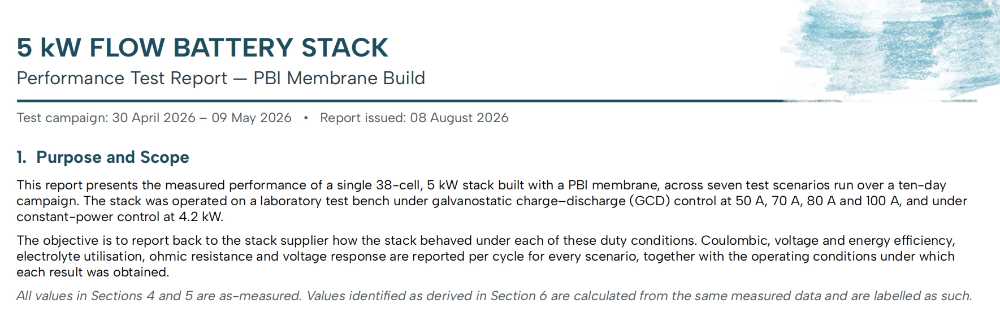
At 83.33mA/cm² (50A), the stack achieved an energy efficiency (EE) of 84.55%. Within the commonly used operating range of 70–80A, EE remained steady at 82.0%–83.2%. Even at the high current density of 166.66 mA/cm² (100A), EE retained 79.24%. Voltage efficiency declined gently as current density rose, demonstrating the superior ionic conductivity of the membrane.
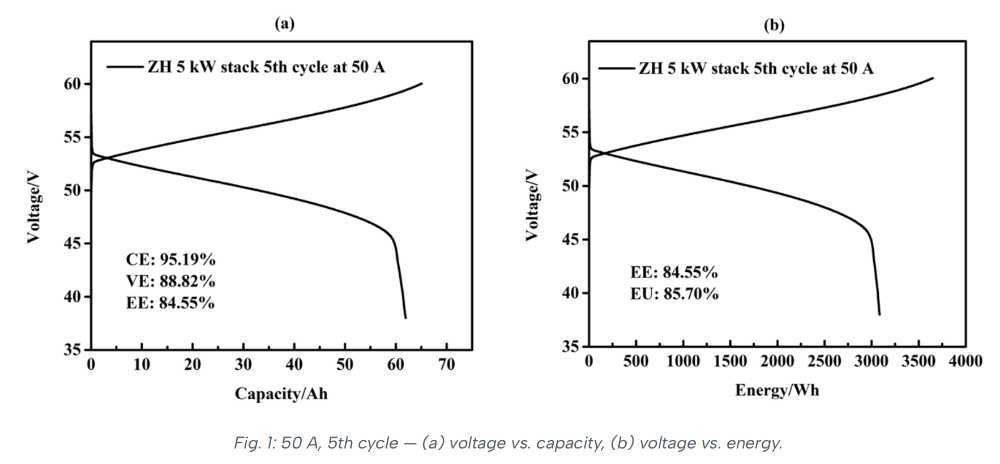
Coulombic efficiency (CE) stayed above 95% across the full stable operating window, reaching 97.3%–98.8% under 70–100A. A peak CE of 99.14% was recorded in the 4.2kW constant-power test, confirming the ultra-low vanadium ion crossover of the PBI membrane, with cross-loss further reduced at elevated current densities.
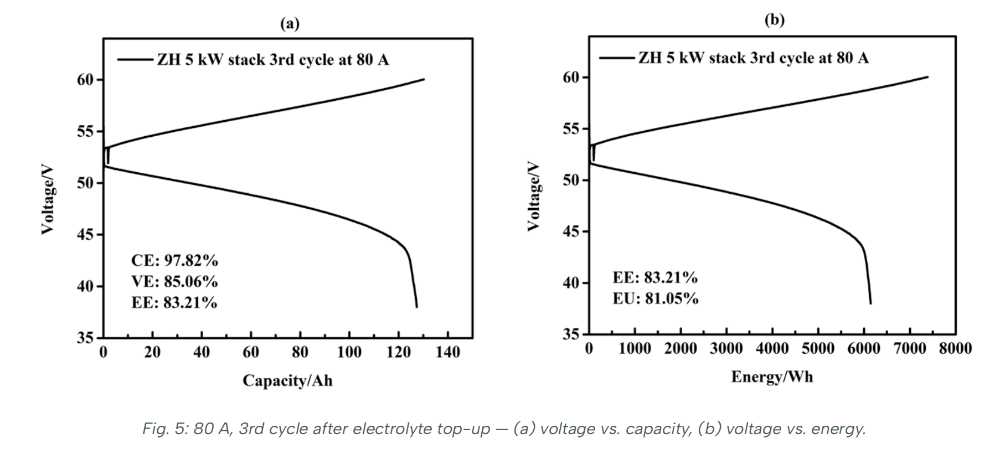
During the entire test, stack ohmic resistance stabilized between 37.0mΩ and 41.8mΩ with no upward trend, corresponding to an area-specific resistance of merely 0.61Ω·cm². Repeated 70A tests conducted 3 days apart and 80 A tests before and after electrolyte mixing showed EE deviation within 1.2%, reflecting excellent performance consistency and repeatability.

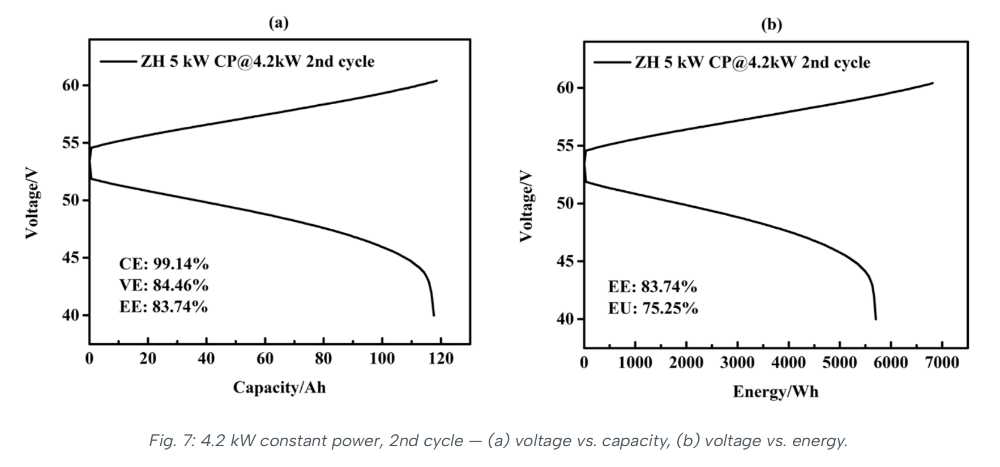
Notably, the 4.2kW constant-power condition best mimics actual dispatch profiles of real-world power stations. Measurements show the stack delivers continuous stable output across the full voltage window of 60.04V–40V, with a single-cycle discharge capacity of 5.71kWh, EE of 83.74% and CE of 99.14%. This proves that under continuous-load field operating conditions, the PBI membrane maintains minimal vanadium crossover loss and delivers optimal CE across operating regimes, well suited to the power and performance requirements of typical use cases including peak shaving & frequency regulation, peak-valley arbitrage and backup power.
The membrane is the “quiet” core component of all-vanadium flow batteries. It does not generate electricity, yet dictates the overall stack efficiency. Vanadium ion crossover erodes energy efficiency; high resistance drags down voltage efficiency; membrane degradation triggers system shutdown. Thus, the true capability of a membrane can only be proven when installed in a real stack and tested through full operating cycles.
For the flow battery industry, every overseas field validation of domestically developed core materials strengthens supply chain self-reliance and builds global credibility for Chinese manufacturing. Porimion® PBI flow battery membranes by Hechen New Materials have completed multi-specification, multi-scenario customer validation and bulk delivery overseas. The full-condition test results on the 5 kW stack serve as another solid proof of Porimion® PBI membrane performance.
As the global long-duration energy storage market continues to expand, ZH Energy will keep advancing core material R&D iterations, supplying more reliable, high-performance membrane solutions for flow battery manufacturers worldwide and jointly fostering a new ecosystem for the long-duration energy storage industry.